A look back at an ascent of the Old Man of Hoy after nearly 20 years!
A couple of weeks ago the UK Climbing website showed a video of Catherine Destivelle soloing the Old Man of Hoy in 1998, this got me thinking about my own ascent of the Old Man in September 2000. As I approach the twenty year anniversary of this ascent, I still consider it a highlight of my climbing career.

Despite working away for the early part of the year, the year 2000 was probably my most prolific year of rock climbing, with most weekends dominated by climbing in the Lancashire quarries. My notes from that year show regular leading and seconding in the HVS 5a to E2 5b range of grades. A plan was hatched for myself, Bob Wardell, Peter Reynolds and Andy Sutton to travel up to Orkney to climb the Old Man at the end of the summer.
As the trip got closer, it became apparent that Andy was quite unwell and would not be able to join us. We would still make the trip, but there were some questions about the logistics of the climb. On 2nd September, we set off from Rochdale at six in the morning. We had five hundred miles to cover before we could catch our mid afternoon ferry from Scrabster, very much the top of mainland Britain and only a few miles from John o’ Groats.
The ferry, the St. Ola, took us across the Pentland Firth to Stromness. During the ninety minute journey we saw whales, seals, dolphins and an array of seabirds. We also had our first sighting of the Old Man as we passed by the island of Hoy. Stromness is the second town of Orkney, after the capital Kirkwall. It is its main port and developed on a large natural bay. We spent the night at a great campsite in the settlement of Ness, at the northern end of the bay, camped just twenty yards from the sea.
The next morning we drove half a dozen or so miles south of Stromness to Houton. To catch the small car ferry that would take us across Scapa Flow to Hoy. Scapa Flow was one of those places that I had heard of but did not know its significance. The relatively shallow and sheltered body of water was an important staging post for Viking fleets. In the First World War, it became home for the British Grand Fleet and at the end of the war seventy-four ships of the Kaiserliche Marine were interned in Scapa Flow awaiting the outcome of the Treaty of Versailles, fearing that the fleet would fall in to British hands, Rear Admiral Ludwig von Reuter ordered the scuttling of ships.
Despite a major scrap salvage operation in the 1920s and 1930s a number of wrecks remain and we passed numerous dive boats on our way across Scapa Flow. There is a small museum at Lyness on Hoy, which charts the history of Scapa Flow and the islands that surround it.
We drove across Hoy from Lyness to Rackwick Bay, stopping at the Youth Hostel at the start of the path to the Old Man. On its garden wall rests a sign which warns climbers that the Old Man is a serious undertaking and if you get in trouble, there is no one to help. We rang the number for the warden of the hostel, which was posted in the window and paid about £20 for the three of us to stay for one night and he left us to it.

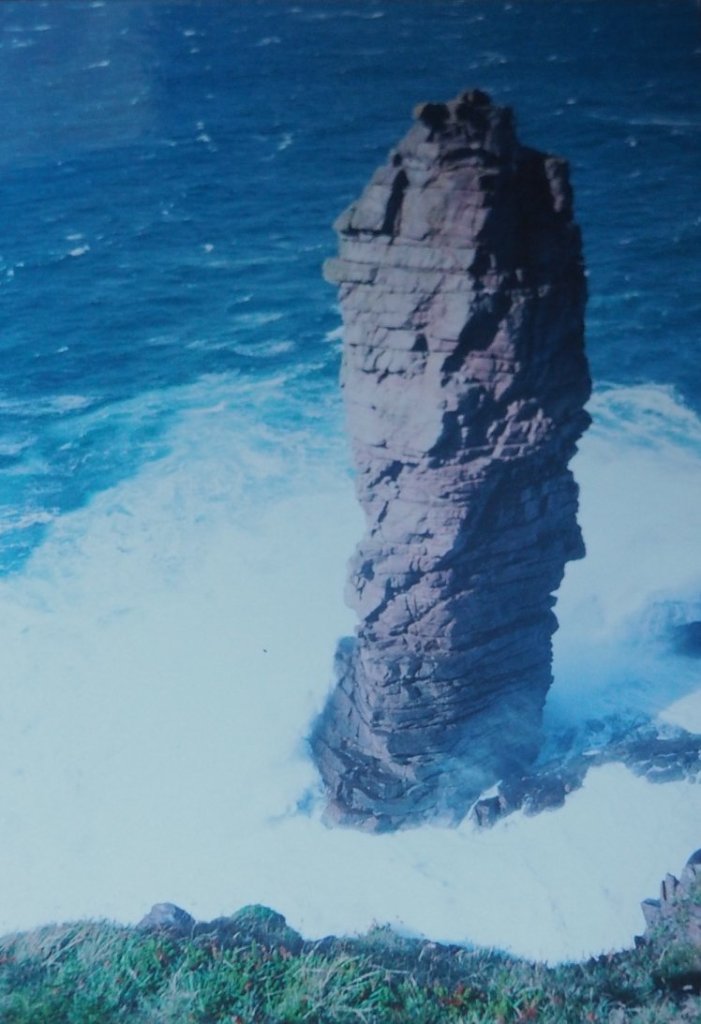
We took a walk along the cliff tops to take a proper look at our objective, seeing it properly for the first time I was somewhat overwhelmed by the scale and complexity of the stack. Even the descent to the base of the climb looked daunting. I have to admit some anxiety, mixed with excitement, which did not leave me for some time.
We had a relaxed evening sorting equipment preparing a meal and relaxing with a drink before an early night. I did not sleep well. I don’t think that I was imaging disaster, but I was definitely mentally summoning climbing strength and rehearsing self-rescue techniques in my mind.
The original plan had been for us to climb in two pairs, but with Andy too ill to take part in the trip, it looked like we would be climbing as a party of three, with the added complications that brings. That evening Bob told us that he had decided that he would not climb, as he felt that climbing as a three probably created too much risk. Whilst I totally understood the logic behind this decision and respected him for the sacrifice that he was making, it probably added to my anxiety, as it amplified the seriousness of the climb in my mind. I would miss his experience on the climb, if not his endless ability to faff.
The next morning we ate a simple breakfast and walked along the cliff tops. Upon reaching the Old Man our first task was to descend the path to the sea. Whilst none of the route presented any technical difficulty, it required great care, particularly on the steeply sloped grass sections, where a slip would result in a fall of several hundred feet. After fifteen or twenty minutes of careful walking we reached the bottom, organised our kit and changed in to our climbing shoes.
We had decided that I would lead pitch one, three and five and that Pete would lead pitches two and four. I don’t mind admitting that Pete was a stronger climber than myself, leading a couple of E grades harder at that time and it made sense that he should lead the crux pitch. However it would mean that I would be climbing technical grades that I would find challenging in ideal conditions, whilst wearing a rucksack.
My memory of the first pitch is of very easy climbing up to the gallery, a large ledge usually occupied by vomiting fulmars. On that day, thankfully relatively free of its usual inhabitants. My notes of the climb say “very straightforward, probably 4a rather than 4b”. I brought Pete up and Bob followed soloing. The highest he would climb on the route. We switched leads and Pete set off on the crux 5b second pitch.
The second pitch initially takes the route from the south-east corner of the stack on to the centre of the east face. I watched Pete move himself carefully along the traverse to the base of the big corner crack, which allows access through the distinct overhang of the first half of the stack. Within a few moves he was gone from site, I carefully and slowly paid out rope for what seemed like an eternity, using the walkie-talkies, I managed to confirm that he was at the top of the pitch and had secured a belay.

I climbed down a couple of metres and tentatively thought about moving right, whilst there were footholds, almost a ledge even, three or four good handholds were essential. Whilst I could see them, I was struggling to trust my ability to make the moves. This wasn’t helped by the small rucksack that I was carrying, which was subtly pulling my centre of gravity away from the rock and towards the abyss. A couple of times I made the first move then retreated, then finally I went for it and within ten seconds, I was safely in the corner.
I remember looking up the corner and thinking “how do I climb this?” I made a few moves, good feet, but not a lot for my hands, talking out a piece of protection as I went. As I got further up the crack, the easier it got, but despite moving well I knew I had a problem. I was in what I know now is referred to as the coffin, the narrow chimney that I would have to climb out of to overcome the overhang, but there was no way I could do that with the rucksack on, it simply got in the way.
Bridging on good footholds, I attached a sling to my harness and attached the other end to the carry loop on the top of the rucksack, then carefully removed the rucksack from my back and lowered it so it hung below me. Now I could move more freely and move out to the lip of the chimney and make the back out on to the face. Once I was comfortable with my feet and sure that I had at least one good hand hold, I carefully reversed the procedure and the last few metres to the belay.
The route description that we had gave a grade of 4c for the third pitch, however my memory is of very straightforward well protected climbing over a series of easy ledges and a crack with good holds. Pete led pitch four, which again was straightforward and only graded 4b, the trickiest section probably being a slabby wall.

I set off on the final pitch. At 4b it should have been very easy, after a few moves it felt a bit more challenging than that. Protection was fairly plentiful and I never felt in danger, but after successful negotiating the harder pitches without mishap, pride more than anything meant that I did not want to fall off. After another few metres of harder than expected climbing, it got easier and I was able to enjoy the most incredible setting.
Looking down I could see the sea more than 400 feet beneath me, or looking northwards I could see the 1,200 foot cliffs of St. John’s Head. Perhaps most spectacular, through the crack which splits the top fifty feet of the Old Man, I could look out across the Atlantic, feeling the breeze with nothing between me and North America.
I topped out and set up a belay, whilst breathing in where I was. Once the belay was set up, I found myself a perch and starting bringing Pete up. My notes record “a bit of a sting in the tail, although the rock was good the technical grade was higher than 4b, I thought 4c, Pete thought it may even have been 5a.” I note that in my Scottish Mountaineering Club Climbers’ Guide, published in 2005, gives it 4c, also adding that it is the best pitch of the route, something that I would agree with.

We spent a pleasant twenty minutes on the summit of the stack, snacking on sausage rolls and cheese and chatting with Bob via our walkie-talkies, before we started to think about our descent. In many ways the descent worried me more than the climb, five abseils, including the overhanging second pitch. It was at this point that Pete told me that he had very limited experience of abseiling.
I was very aware that Tom Patey, the great pioneer of stack climbing in Scotland and one of the party to make the first ascent in 1966 along with Rusty Baillie and Chris Bonington, had died in an abseiling accident, after climbing the Eastern Stack of the Maiden in 1970. Patey had abseiled off the end of his rope. I was determined that this was not going to happen to me and had devised a simple safety system involving prusik loops attached to the ropes above the figure of eight abseil device and attached to our harnesses. One hand would control the figure of eight, whilst the other the prusik loop brake.
After deciding that I would take responsibility for setting up and dismantling the abseils, I explained the safety system to Pete and we started the long descent. With Pete abseiling each pitch first. The vertical or off vertical pitches five, four and three passed without hitch. On the second pitch as Pete hung in free space, ten feet out from the rock face, we realised that we had a problem.
This was the point where we needed to traverse to the south-eastern corner of the stack to regain the gallery. A rope is strung across this section to enable climbers to pull themselves across, but to be able to do this, Pete needed to be able to make contact with the rope, a task that seemed impossible. He tried to create some swing in the rope, but this did not work. The situation seemed somewhat desperate.
Pete suggested that he could abseil off the end of the rope and drop the short final distance to the ground. I strongly expressed a view that this would be a very bad idea. The distance to the ground was by my estimate six or seven metres beyond the end of the ropes, on to a very poor landing. Plus I would still have to solve the problem when it was my turn. After a few more minutes we hatched a plan. The traversing rope was hanging free from the rock face and if we could get the ends of the abseil ropes to hang behind that rope, they would naturally bring the abseiler to the traverse rope. Pete tied the heaviest thing that he had to hand – a very large camming device. Bought specially for the climb – to the end of the ropes and after few attempts managed to hit his target.
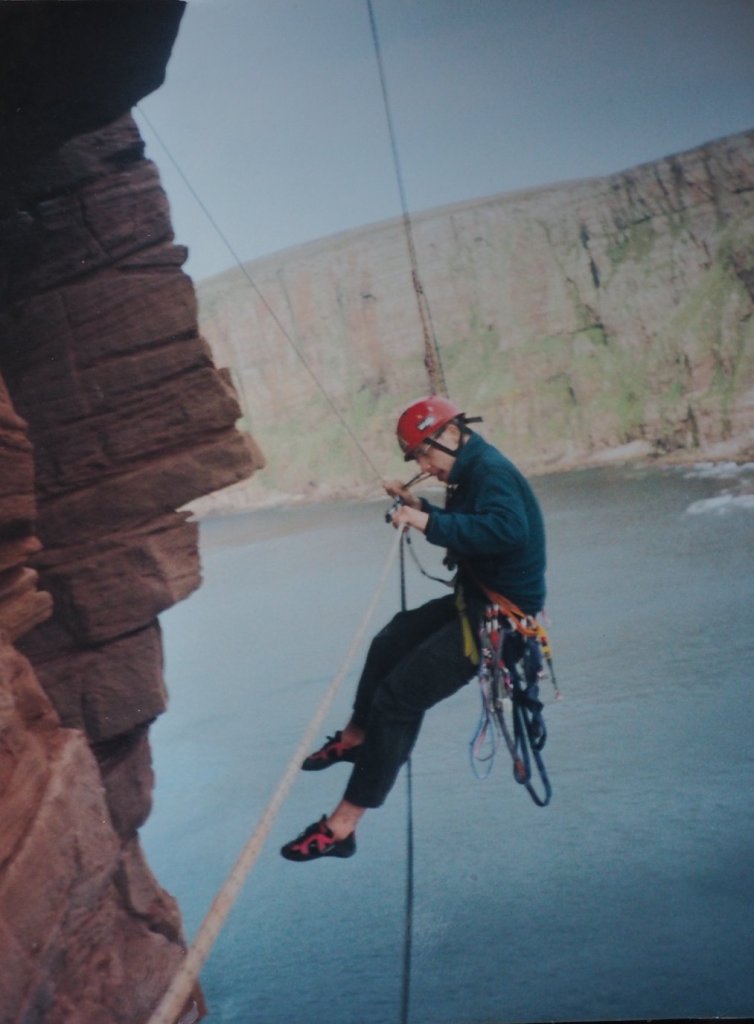
When it was my turn to descend, I quite enjoyed the abseil in to free space. However when I got to the traverse rope, despite having a mechanical ascender (basically a handle which could grip on the rope and move in one direction, but not the other) I had a hell of a battle traversing across to the gallery. Eventually getting there, my fear was that we would not be able to retrieve the rope. Thankfully it came free with minimal effort.
Our descent, with the traverse left to the gallery, was very much the normal descent at the time. However, we had heard that it was possible to make a much simpler descent from the top of the second pitch straight to the ground using 60 metre ropes. Whilst 60 metre ropes are very much the norm these days, they were still exotica associated with European sport climbing then and we didn’t own any.
On the previous four abseils we have been protected from the wind by the mass of the Old Man, but our final abseil was exposed to the Atlantic breeze, which by this time was a little more than a breeze and made it hard to descend our desired route, as the wind tried to blow the ropes around the stack. Eventually I reached the ground very happy, but exhausted. All we needed to do now was walk back up the path to the cliff top and along the headland to Rackwick Bay.
The walk up to the top of the cliff was hot and in my exhausted state seemed to take an age. We spent the night staying in the Bothy on Rackwick Bay. After a few beers and some whisky, I slept well. The following day we took the ferry back to Orkney Mainland and then the ferry to Scrabster.
The rest of the trip was also hugely enjoyable. We camped for a couple of nights on the Stoer Peninsular and walked to the Old Man of Stoer. We had a plan to climb that, but were put off by the prospect of a cold swim in wild seas. We spent a day bouldering on the sea cliffs of Reiff and travelled to Skye, where we climbed the Cioch Nose (Very Difficult) in Sron Na Ciche in the pouring rain in walking boots.

Bob and Andy flew to Orkney in September 2001 and made their own ascent of the Old Man of Hoy.
 Thoughts and Memories